Posts

PUMA PUNKU, TIWANAKU

Image
Pumapunku, also called “Puma Pumku” or “Puma Puncu”, is part of a large temple complex or monument group that is part of the Tiwanaku Site near Tiwanaku, Bolivia. In Aymara, its name means, “The Door of the Cougar”. The quality of the stonework and the size of the blocks is amazing, and there is evidence that machines were used to cut, polish and drill in the blocks of stones. Some of the blocks weigh over 100 tons and they are so perfectly polished with fine absolutely straight cut lines, just millimeters in depth with drilled holes with an exact distance between them. Puma Punku is placed about 13,300 feet (4000 meters) over sea level, and no trees will grow on this height, so there was no possibility to use tree rollers to transport the megalithic stones. The stones used at Puma Punku are made of diorite and granite, the only stone that is hard enough to cut diorite is diamond. Can this all be done by the people of 10,000 BC era???? Or did they find some h...

ZONE OF SILENCE, MEXICO

Image
The Mapimí Silent Zone is the popular name for a desert patch in Mexico overlapping the Mapimí Biosphere Reserve that is the subject of an urban myth that claims it is an area where radio signals cannot be received. On July 11, 1970, an Athena missile launched from White Sands Missile Range lost control and fell in the region. The rocket was carrying two small containers of cobalt 57, a radioactive element. Immediately, a team of specialists arrived to find the fallen rocket. The aerial search lasted three weeks. Finally, when the rocket was found, a road was built to transport the wreckage, along with a small amount of contaminated top soil. As a result of the US Air Force recovery operations there, a number of myths and stories relating to the area arose, including "strange magnetic anomalies that prevent radio transmission", mutations of flora and fauna, and extraterrestrial visitations. Numerous reports by local residents of UFO sightings and contact with extra-t...

NAZCA LINES

Image
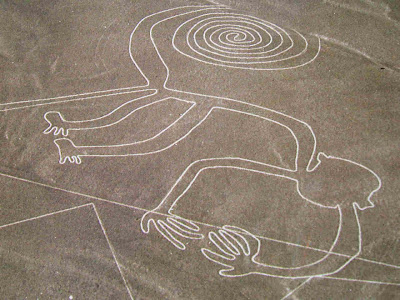
The Nazca Lines are a series of ancient geoglyphs located in the Nazca Desert in southern Peru. They were designated a UNESCO World Heritage Site in 1994. The hundreds of individual figures range in complexity from simple lines to stylized hummingbirds, spiders, monkeys, fish, sharks,orcas, llamas, and lizards. The lines are shallow designs made in the ground by removing the ubiquitous reddish pebbles and uncovering the whitish ground beneath. Hundreds are simple lines or geometric shapes; more than seventy are zoomorphic designs of animals such as birds, fish, llamas, jaguar, monkey or human figures. Other designs include phytomorphic shapes such as trees and flowers. The largest figures are over 200 metres (660 ft) across. Scholars differ in interpreting the purpose of the designs, but in general they ascribe religious significance to them.

PETRA

Image
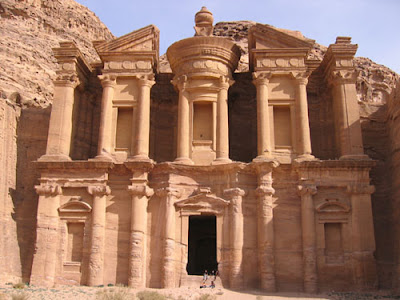
Petra is a historical and archaeological city in the Jordanian governorate of Ma'an that is famous for its rock cut architecture and water conduits system. Established sometime around the 6th century BC as the capital city of the Nabataeans, it is a symbol of Jordan as well as its most visited tourist attraction. It lies on the slope of Mount Hor in a basin among the mountains which form the eastern flank of Arabah (Wadi Araba), the large valley running from the Dead Sea to the Gulf of Aqaba. Petra has been a UNESCO World Heritage Site since 1985. The site remained unknown to the Western world until 1812, when it was introduced by Swiss explorer Johann Ludwig Burckhardt. It was described as "a rose-red city half as old as time" in a Newdigate Prize-winning poem by John William Burgon. UNESCO has described it as "one of the most precious cultural properties of man's cultural heritage". Petra was chosen by the BBC as one of "the 40 places you have ...

COLOSSEUM

Image
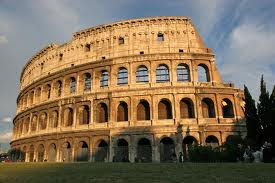
The Colosseum, or the Coliseum, originally the Flavian Amphitheater is an elliptical amphitheater in the centre of the city of Rome, Italy, the largest ever built in the Roman Empire. It is considered one of the greatest works of Roman architecture and Roman engineering. Occupying a site just east of the Roman Forum, its construction started in 72 AD under the emperor Vespasian and was completed in 80 AD under Titus, with further modifications being made during Domitian's reign (81–96). The name "Amphitheatrum Flavium" derives from both Vespasian's and Titus's family name (Flavius, from the gens Flavia). Capable of seating 50,000 spectators, the Colosseum was used for gladiatorial contests and public spectacles such as mock sea battles, animal hunts, executions, re-enactments of famous battles, and dramas based on Classical mythology. The building ceased to be used for entertainment in the early medieval era. It was later reused for such purposes as ho...

GREAT WALL OF CHINA

Image
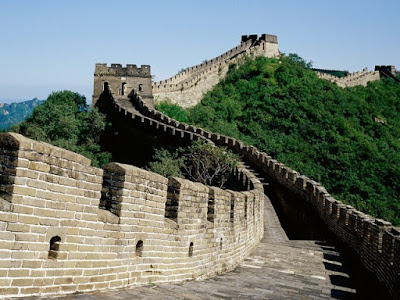
The Great Wall of China is a series of stone and earthen fortifications in northern China, built originally to protect the northern borders of the Chinese Empire against intrusions by various nomadic groups. Several walls have been built since the 5th century BC that are referred to collectively as the Great Wall, which has been rebuilt and maintained from the 5th century BC through the 16th century. One of the most famous is the wall built between 220–206 BC by the first Emperor of China, Qin Shi Huang. Little of that wall remains; the majority of the existing wall was built during the Ming Dynasty. The Great Wall stretches from Shanhaiguan in the east, to Lop Lake in the west, along an arc that roughly delineates the southern edge of Inner Mongolia. The most comprehensive archaeological survey, using advanced technologies, has concluded that the entire Great Wall, with all of its branches, stretches for 8,851.8 km (5,500.3 mi). This is made up of 6,259.6 km (3,889.5 mi) sectio...

CHRIST THE REDEEMER

Image
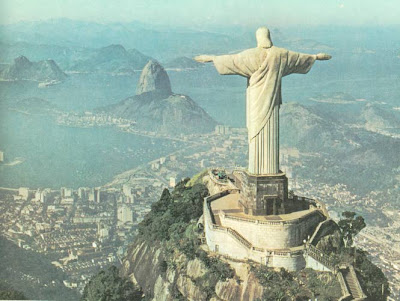
Christ the Redeemer  is a statue of Jesus Christ in Rio de Janeiro, Brazil; considered the largest Art Deco statue in the world and the world's 4th largest statue of Jesus Christ. It is 39.6 metres (130 ft) tall, including its 9.5 metres (31 ft) pedestal, and 30 metres (98 ft) wide. It weighs 635 tonnes (625 long,700 short tons), and is located at the peak of the 700-metre (2,300 ft) Corcovado mountain in theTijuca Forest National Park overlooking the city. A symbol of Christianity, the statue has become an icon of Rio and Brazil. It is made of reinforced concrete and soapstone, and was constructed between 1922 and 1931.