Posts

PETRA

Image
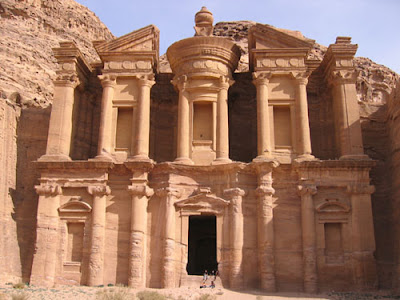
Petra is a historical and archaeological city in the Jordanian governorate of Ma'an that is famous for its rock cut architecture and water conduits system. Established sometime around the 6th century BC as the capital city of the Nabataeans, it is a symbol of Jordan as well as its most visited tourist attraction. It lies on the slope of Mount Hor in a basin among the mountains which form the eastern flank of Arabah (Wadi Araba), the large valley running from the Dead Sea to the Gulf of Aqaba. Petra has been a UNESCO World Heritage Site since 1985. The site remained unknown to the Western world until 1812, when it was introduced by Swiss explorer Johann Ludwig Burckhardt. It was described as "a rose-red city half as old as time" in a Newdigate Prize-winning poem by John William Burgon. UNESCO has described it as "one of the most precious cultural properties of man's cultural heritage". Petra was chosen by the BBC as one of "the 40 places you have ...
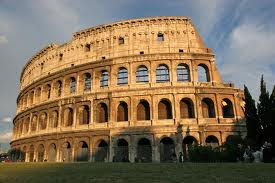
COLOSSEUM

Image
The Colosseum, or the Coliseum, originally the Flavian Amphitheater is an elliptical amphitheater in the centre of the city of Rome, Italy, the largest ever built in the Roman Empire. It is considered one of the greatest works of Roman architecture and Roman engineering. Occupying a site just east of the Roman Forum, its construction started in 72 AD under the emperor Vespasian and was completed in 80 AD under Titus, with further modifications being made during Domitian's reign (81–96). The name "Amphitheatrum Flavium" derives from both Vespasian's and Titus's family name (Flavius, from the gens Flavia). Capable of seating 50,000 spectators, the Colosseum was used for gladiatorial contests and public spectacles such as mock sea battles, animal hunts, executions, re-enactments of famous battles, and dramas based on Classical mythology. The building ceased to be used for entertainment in the early medieval era. It was later reused for such purposes as ho...

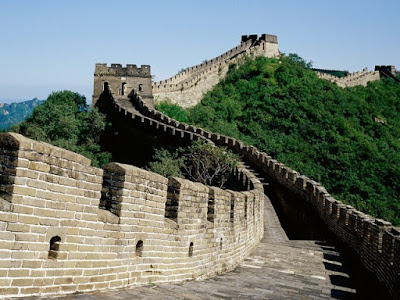
GREAT WALL OF CHINA

Image
The Great Wall of China is a series of stone and earthen fortifications in northern China, built originally to protect the northern borders of the Chinese Empire against intrusions by various nomadic groups. Several walls have been built since the 5th century BC that are referred to collectively as the Great Wall, which has been rebuilt and maintained from the 5th century BC through the 16th century. One of the most famous is the wall built between 220–206 BC by the first Emperor of China, Qin Shi Huang. Little of that wall remains; the majority of the existing wall was built during the Ming Dynasty. The Great Wall stretches from Shanhaiguan in the east, to Lop Lake in the west, along an arc that roughly delineates the southern edge of Inner Mongolia. The most comprehensive archaeological survey, using advanced technologies, has concluded that the entire Great Wall, with all of its branches, stretches for 8,851.8 km (5,500.3 mi). This is made up of 6,259.6 km (3,889.5 mi) sectio...

CHRIST THE REDEEMER

Image
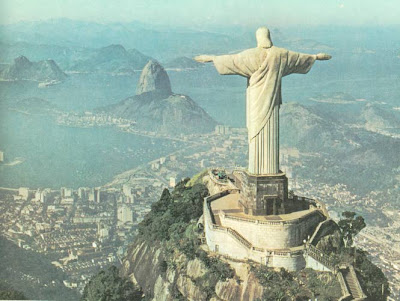
Christ the Redeemer  is a statue of Jesus Christ in Rio de Janeiro, Brazil; considered the largest Art Deco statue in the world and the world's 4th largest statue of Jesus Christ. It is 39.6 metres (130 ft) tall, including its 9.5 metres (31 ft) pedestal, and 30 metres (98 ft) wide. It weighs 635 tonnes (625 long,700 short tons), and is located at the peak of the 700-metre (2,300 ft) Corcovado mountain in theTijuca Forest National Park overlooking the city. A symbol of Christianity, the statue has become an icon of Rio and Brazil. It is made of reinforced concrete and soapstone, and was constructed between 1922 and 1931.

CHICHEN ITZA

Image
Chichen Itza is a large pre-Columbian archaeological site built by the Maya civilization located in the northern center of the Yucatán Peninsula, in the Municipality of Tinúm,Yucatán state, present-day Mexico. Orthern Yucatán is arid, and the rivers in the interior all run underground. There are two large, natural sink holes, called cenotes, that could have provided plentiful water year round at Chichen, making it attractive for settlement. Of the two cenotes, the "Cenote Sagrado" or Sacred Cenote(also variously known as the Sacred Well or Well of Sacrifice), is the most famous. According to post-Conquest sources (Maya and Spanish), pre-Columbian Maya sacrificed objects and human beings into the cenote as a form of worship to the Maya rain god Chaac. Edward Herbert Thompson dredged the Cenote Sagrado from 1904 to 1910, and recovered artifacts of gold, jade,pottery, and incense, as well as human remains. El Caracol To the north of Las Monjas is a cockeyed, round...

ST. MICHAEL’S GOLDEN-DOMED MONASTERY, UKRAINE

Image
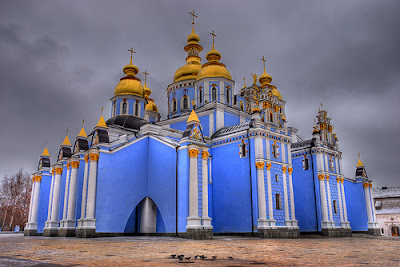
This amazing blue monastery is on the Dneiper River in Kiev, Ukraine. First built in the Middle Ages, but was destroyed by the Soviets in 1934. In 1999 it was rebuild after Ukraine regained its independence.

POPA TAUNGKALAT SHRINE, BURMA

Image
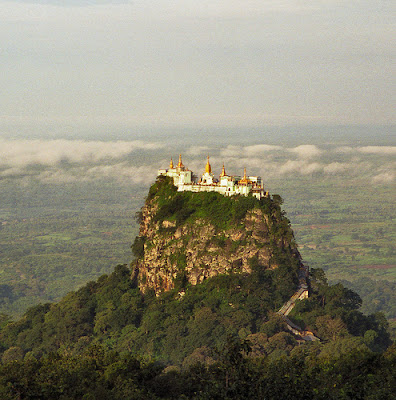
This Shrine is home to 37 Mahagiri spirits. Statues depicting the spirits are at the base of the Shrine. At the 777 steps to the summit, you will be asked to remove your socks and shoes. Hungry monkeys will be greeted along the way, so bring something to feed them or keep your belongings close to you, they may run off with your lunch.